

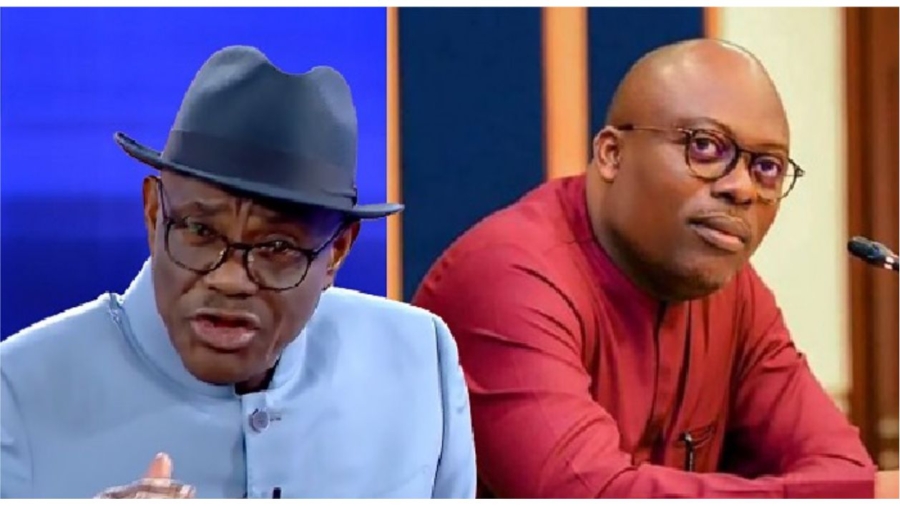
“Godfather or Governor? The Wike-Fubara Power Struggle Shaping Rivers State’s Future”
In Nigeria’s complex political theatre, allegiances can shift as fast as the tides of the Niger Delta. But few stories have captivated the nation’s attention — and rattled the corridors of power — like the unfolding saga between Nyesom Wike, former governor of Rivers State and now Minister of the Federal Capital Territory, and Siminalayi Fubara, his one-time protégé and successor as governor.
What began in 2023 as a seemingly smooth transition of leadership quickly metastasized into one of the most protracted and bitter political rifts in recent memory — a battle not just over offices, but over legacy, loyalty and the very soul of Rivers State. 
⸻
From Protégé to Political Rival
Siminalayi Fubara rose to the governorship of Nigeria’s oil-rich Rivers State riding the enormous political influence of his mentor, Nyesom Wike. During Wike’s tenure as governor (2015–2023), Fubara served as Accountant-General of the state, a trusted lieutenant who seemed poised to carry forward Wike’s political agenda. 
But almost immediately after the handover of power, fissures began to appear. What was meant to be continuity turned into dissonance. Fubara’s moves to assert autonomy — from challenging budget approvals to resisting directives from Wike’s loyalists — signaled the emergence of a political identity that was increasingly his own. 
⸻
The Rift Deepens: Politics, Power and Perception
The conflict between these two powerful men spiraled quickly into a full-blown political crisis — one that split the Rivers State House of Assembly, saw commissioners resign en masse, and drew national attention for its volatility and potential to destabilize the region. 
At the heart of the dispute lies a classic Nigerian political dilemma: godfather versus successor. Wike, a seasoned political operator with deep networks across party lines, appeared intent on maintaining influence over the direction of Rivers State. Fubara, on the other hand, aimed to shed the label of a mere proxy and govern on his own terms — a move that was met with fierce resistance. 
Disagreements over appointments and the structure of the cabinet became flashpoints, and the political temperature soared. A peace agreement brokered by national actors initially brought hopes of resolution, but it quickly collapsed amid mutual accusations and recriminations. 
⸻
Federal Intervention and National Stakes
The crisis escalated to such a degree that President Bola Tinubu declared a six-month state of emergency in Rivers State — suspending Fubara, the deputy governor, and the entire House of Assembly — and appointed a sole administrator to oversee governance. It was a dramatic intervention that underscored how local disputes can quickly become national issues. 
This unprecedented move highlighted not just the intensity of the feud, but also the broader political ramifications. Rivers State — the economic backbone of the Niger Delta — became a litmus test for governance, party control, and federal influence over sub-national politics. 
⸻
“He’s My Boy — But…”
Despite public displays of animosity, Wike has at times sought to recast the narrative. In interviews, he has described Fubara not as an enemy, but as his political son, insisting that the chief battle was against corrupt influences and not the governor himself. 
To some observers, this rhetoric reflects political theatre — a strategic attempt to deflect criticism while maintaining leverage over a former protégé who has defied expectations.
⸻
Calls for Peace — And the Stakes for Rivers
Concerned voices from within and outside Rivers State have urged calm. Former President Goodluck Jonathan appealed for collaboration between Wike and Fubara, warning that continuous conflict would harm the people of the state. Traditional rulers have even formed a peace committee to mediate the crisis, underscoring how deep and disruptive the dispute has become. 
The stakes are high. Rivers State’s stability affects national economics, local livelihoods, and Nigeria’s broader democratic health. When two of its most powerful figures clash, the reverberations are felt far beyond Port Harcourt. 
⸻
Legacy, Loyalty or Power?
Ultimately, the Wike-Fubara saga is more than a personal dispute: it is a lesson in the paradoxes of political mentorship and the perils of godfather politics. In a democratic system still finding its footing, the drama unfolding in Rivers State forces a critical question — when should protégés defy their godfathers? And at what cost to governance and public trust? 
As Rivers watches, Nigeria debates — and as both leaders gear up for elections and political realignments ahead, the outcome of this rift could shape political norms for years to come.
By Fawumi Abiodun
Ekocity Magazine
Add a Comment