

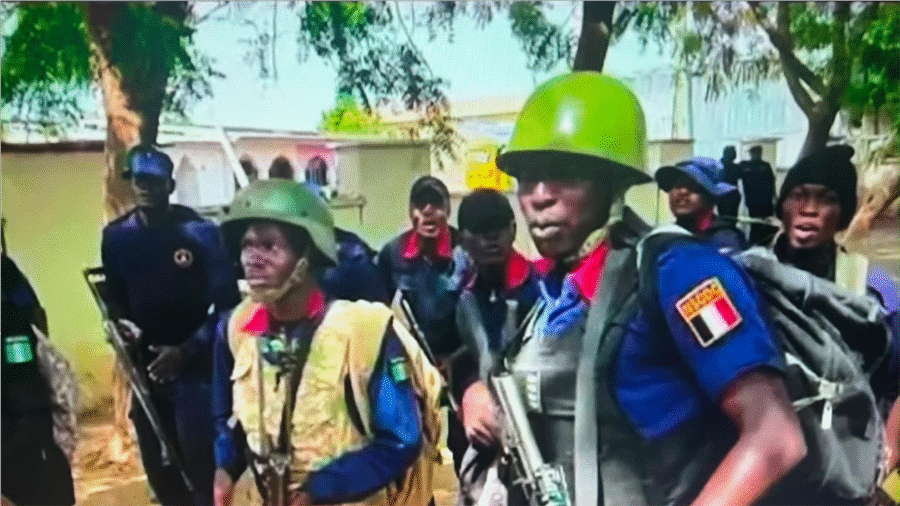
THE MINNA TRAGEDY
33 Miners Dead in NSCDC Custody — Questions Now Demand Answers
What began as an operation against illegal mining has become a grave test of detention standards, accountability and the state’s duty to protect people in its custody.
Exclusive to Ekocity | National Affairs & Investigations Desk
MINNA — A crackdown on illegal mining in Niger State has taken a tragic and disturbing turn.
At least 33 suspected illegal miners are reported to have died while in the custody of the Nigeria Security and Civil Defence Corps, after their arrest during an enforcement operation in the Minna area.
The deaths were discovered in the early hours of Thursday, September 17, according to the Niger State Command of the NSCDC. The agency has confirmed that detainees died, but says the exact cause remains under investigation.
The suspects were arrested during what the Corps described as a “burst operation” conducted on September 15 and 16 around M.I. Wushishi and Lukoto Village, as part of a renewed campaign against illegal mining.
Scores of people were arrested and mining-related exhibits recovered. Two days later, tragedy struck inside the detention facility. The NSCDC says the detainees were found dead following a suspected outbreak of disease. Their bodies have been transferred to the General Hospital in Minna for medical examination intended to establish what actually happened.
THE NUMBER 33
The number itself has become part of the controversy. While the NSCDC’s initial statement referred only to “scores” of detainees, subsequent reports from several Nigerian news organisations have put the number at 33. NSCDC officials have also been quoted confirming the figure.
For families, however, this is not a statistic.
It is a son.
A husband.
A brother.
A father.
And the circumstances surrounding each death now demand answers.
WHAT CAUSED THE DEATHS?
This may be the most important unanswered question. The NSCDC has said only that there was a suspected disease outbreak. Some reports have attributed the deaths to possible diphtheria, while other accounts have raised the possibility of toxic exposure. Neither explanation has been established officially.
The medical examination is therefore critical. Until laboratory and medical findings are released, responsible reporting should resist the temptation to declare a cause of death. What can be established is that people who were alive when they entered detention died within a short period while under the state’s custody. That fact alone requires a transparent investigation.
QUESTIONS ABOUT THE DETENTION FACILITY
Reports from relatives and survivors have raised additional concerns about the conditions in which the suspects were detained. One survivor quoted by New Telegraph alleged that detainees were crowded into a small cell. The report also cited relatives who questioned whether overcrowding contributed to the deaths. These allegations have not been independently established.
That is precisely why an independent investigation is necessary.
Were the detainees medically screened when they arrived?
Were they separated according to health condition?
Was there adequate ventilation?
Was the facility overcrowded?
Were medical personnel available?
When did the first detainee become ill?
And when did authorities realise that something potentially fatal was spreading?
These are not merely questions for the NSCDC.
They are questions about Nigeria’s detention system.
THE FAMILIES ARE DEMANDING ANSWERS
The tragedy has already generated anger in Minna. Reports indicate that relatives and residents gathered around the NSCDC headquarters and other locations seeking information about those arrested. Some protests reportedly disrupted movement in parts of the city.
The Corps has appealed for calm and said it is working with sister security agencies to manage the situation. That appeal is understandable. But calm cannot become a substitute for accountability.
Families have a legitimate right to know how their relatives died.
They deserve medical findings.
They deserve identification of the deceased.
They deserve proper notification.
And where wrongdoing is established, they deserve justice.
ILLEGAL MINING IS NOT A LICENCE FOR NEGLECT
There is another important distinction. Nigeria has a serious illegal-mining problem, and authorities have a legitimate responsibility to enforce mining laws. But being arrested for a suspected offence does not remove a person’s right to life and humane treatment.
A detainee remains in the custody and protection of the state. That principle becomes even more important when deaths occur inside a government detention facility. The enforcement operation itself should therefore not become the end of the investigation. The state must investigate what happened after the arrests.
A MOMENT FOR INDEPENDENT INVESTIGATION
The NSCDC says it remains committed to human rights and international human-rights standards. The most convincing demonstration of that commitment now would be transparency.
An independent medical investigation should establish the cause of death. The detention records should be examined. The number of people arrested should be reconciled with the number released, hospitalised and deceased.
The condition of the detention facility should be assessed. And any officer or official found to have violated established procedures should face appropriate consequences. This is not about weakening the fight against illegal mining. It is about strengthening the credibility of that fight.
THE QUESTIONS MINNA CANNOT IGNORE
The miners were arrested because authorities suspected them of illegal activity. But the larger question now is what happened to them after they were arrested. How did 33 people die in custody within days of their detention?
Until that question is answered with medical evidence and a transparent investigation, the tragedy will remain surrounded by suspicion. For the families waiting outside the morgue in Minna, explanations are no longer enough.
They need facts. For the NSCDC, this is no longer simply an enforcement operation. It is a test of institutional accountability. And for Nigeria, the tragedy carries a reminder that the power to arrest comes with an equally serious responsibility: The state must protect the lives of those it takes into custody.
Ekocity National Affairs & Investigations Desk

Fawumi Kayode Abiodun
Political Analyst | CEO, Ekocity Media | Publisher, Ekocity Magazine and The Capitol Post
Add a Comment