

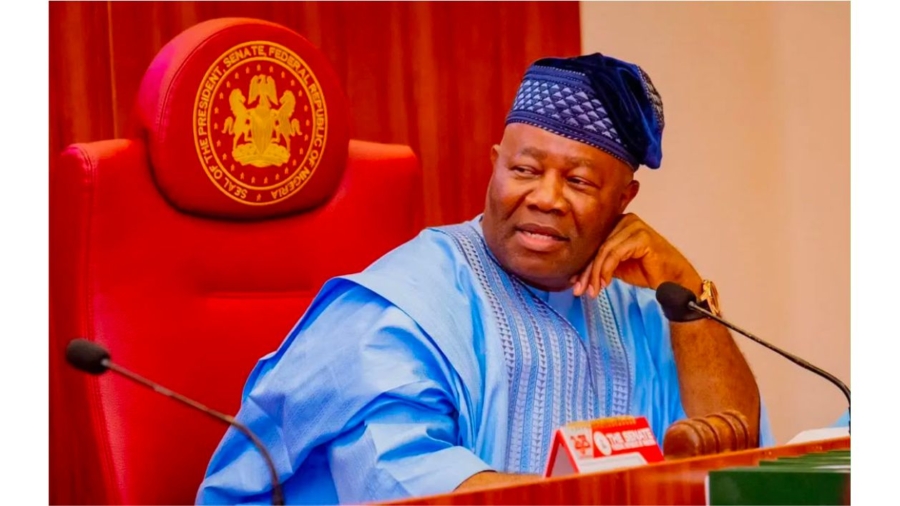
Akpabio Went to Rome to Pray for Nigeria. But Is Prayer the Problem—or the Way We Govern?
By Amb. Fawumi Kayode Abiodun
Prayer has never been Nigeria’s problem. If anything, Nigerians pray too much to suggest that the country suffers from a shortage of faith. From churches to mosques, from roadside prayer meetings to midnight vigils, from mountain retreats to national religious gatherings, Nigerians have developed a remarkable capacity to place their hopes before God. So when Senate President Godswill Akpabio travelled to Italy and visited the prayer ground of St Padre Pio to pray for Nigeria’s security, banditry, terrorism and the peaceful conduct of the 2027 elections, his decision should not automatically be dismissed as absurd. For a deeply religious society, prayer is a legitimate expression of faith. But the bigger question is not why Akpabio prayed.
The bigger question is what happens after the prayer?
Because Nigeria does not merely need divine intervention. Nigeria needs functioning institutions. It needs intelligence that reaches the right people before communities are attacked. It needs security agencies equipped and motivated to protect citizens. It needs courts that work. It needs consequences for those who finance violence. It needs political leaders who can make difficult decisions and accept responsibility for their outcomes. And above all, it needs leadership that understands that prayer and responsibility are not competitors. They should work together.
Akpabio said his pilgrimage was motivated by his Christian belief that without God’s protection, human effort is insufficient. That is a theological position millions of Nigerians would understand. But there is another side to the same biblical idea. If the watchman must watch, then the watchman must actually watch. You cannot pray for the city while leaving the gates open. You cannot pray against banditry while allowing criminal networks to operate with impunity. You cannot pray for peace while political institutions remain incapable of resolving the grievances that produce instability. You cannot pray for economic prosperity while tolerating systems that discourage investment, punish productivity and reward connections over competence. And you cannot pray for good leadership while treating accountability as an attack on the leader.
The danger is not prayer. The danger is religious rhetoric without institutional action. Nigeria’s political culture has often blurred the line between faith and political messaging. Politicians routinely invoke God at campaign rallies, during inaugurations, at national celebrations and whenever the country faces a crisis. There is nothing inherently wrong with that.
The problem begins when religious language becomes a convenient substitute for explaining what government is actually doing.
When a citizen asks:
What is the government doing about insecurity? “Pray for Nigeria” cannot be the entire answer.
The citizen deserves to know how many intelligence personnel have been deployed, how security coordination is improving, how criminal financing is being disrupted, how vulnerable communities are being protected and what measurable results government expects.
Prayer may be personal.
Governance is measurable.
That distinction matters.
Akpabio’s Rome pilgrimage is particularly interesting because he is not an ordinary citizen. He is the President of Nigeria’s Senate—the head of one of the three constitutional arms of government. His words therefore carry institutional weight. When an ordinary Nigerian travels to Rome to pray for Nigeria, it is primarily a personal act of faith. When one of the country’s most powerful political leaders does it publicly while Nigeria is battling insecurity, the public is entitled to ask:
What is government doing alongside the prayer?
That is not an attack on religion.
It is the essence of democratic accountability.
Nigeria is not suffering from a prayer deficit
Nigeria is arguably one of the most prayerful societies in the world.
Yet prayer has not prevented corruption.
It has not eliminated kidnapping.
It has not stopped terrorism.
It has not solved unemployment.
It has not fixed our electricity problems.
It has not transformed our public schools.
It has not stopped political violence.
It has not created functional public transportation.
And it has not built the institutions required to sustain development.
Perhaps the lesson is not that prayer does not work.
Perhaps the lesson is that prayer was never designed to replace human responsibility.
A nation can pray and still plan.
A government can seek divine guidance and still collect intelligence.
A president can attend church or mosque and still enforce the law.
A senator can go on pilgrimage and still demand accountability from security agencies.
A nation can believe in God and still believe in data.
There is no contradiction.
The real Nigerian prayer should be bigger than “God save Nigeria” Perhaps our national prayer should also be:
God, give us leaders who will do their jobs.
Give our security agencies courage.
Give our institutions independence.
Give our judges integrity.
Give our civil servants competence.
Give our politicians restraint.
Give our citizens the courage to demand accountability.
And perhaps most importantly:
Give us the wisdom to understand the difference between what we must pray about and what we must act upon. Because a nation cannot outsource its responsibilities to heaven.
God may provide the rain. But somebody still has to build the drainage.
God may give wisdom. But somebody still has to make the decision.
God may protect the nation. But the watchman must still stay awake.
That may ultimately be the deeper lesson from Akpabio’s journey to Rome.
Nigeria does not need less prayer. It needs more responsibility after prayer. The real test of faith in public office is not how loudly a leader prays. It is what the leader does when the prayer ends.

Fawumi Kayode Abiodun
Political Analyst | CEO, Ekocity Media | Publisher, Ekocity Magazine and The Capitol Post
Add a Comment