

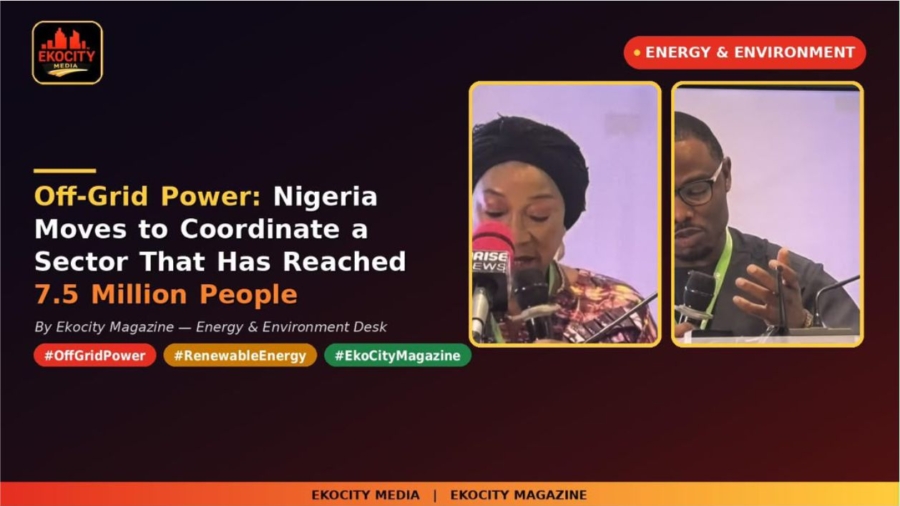
Off-Grid Power: Nigeria Moves to Coordinate a Sector That Has Reached 7.5 Million People
By Ekocity Magazine — Energy & Environment Desk
Nigeria is attempting to bring greater coordination to its rapidly expanding off-grid electricity sector, as government agencies, state governments, private developers and international partners confront the challenge of extending reliable power to millions of people beyond the national grid.
At the centre of the new effort is the Off-Grid Stakeholder Coordination and Partnership Forum, which was officially relaunched in Abuja on September 28, 2026, by the Rural Electrification Agency (REA).
The REA’s Managing Director, Dr Abba Abubakar Aliyu, called for a more unified approach to electricity access, arguing that fragmented interventions risk duplicating projects while leaving other communities underserved. An analysis of the 2024 and 2025 federal budgets using artificial intelligence, he said, identified several government institutions implementing power-related projects, highlighting the need for stronger coordination. The coordination push comes against a backdrop of significant progress in Nigeria’s off-grid sector.
According to the REA and Nigeria Electrification Project data, more than 7.5 million Nigerians have gained electricity access through off-grid interventions, including more than 200 solar hybrid mini-grids and approximately 1.8 million Solar Home System connections. The NEP also supported solar power installations for healthcare facilities and electrification projects in federal universities.
The achievement represents an important shift in how Nigeria approaches its electricity deficit. Instead of relying exclusively on expansion of the national grid, decentralised renewable energy systems can bring electricity directly to communities where conventional grid extension is expensive, slow or technically difficult.
But the next challenge may be harder than simply connecting people.
Stakeholders at the Abuja forum argued that success should increasingly be measured by what happens after electricity arrives.
Ikenna-Donald Ofoegbu of the Heinrich Böll Stiftung Nigeria urged the sector to move beyond counting mini-grids, solar systems and connections and focus more heavily on productive use, sustainability, innovative financing and local capacity.
That distinction matters. Electricity becomes economically transformative when it allows a farmer to irrigate crops, a food processor to operate machinery, a market trader to preserve goods, a clinic to maintain essential equipment or a small manufacturer to increase production.
Nigeria’s next major off-grid programme, Distributed Access through Renewable Energy Scale-Up (DARES), is designed to build on the NEP experience. The programme targets more than 17 million Nigerians and approximately 465 megawatts of renewable-energy capacity through solar hybrid mini-grids and standalone solar systems.
International financing is also beginning to follow the opportunity. In April 2026, the International Finance Corporation and Norfund announced financing of up to $83.2 million to support five renewable-energy service companies expected to extend reliable electricity to nearly 500,000 households and businesses in underserved Nigerian communities.
The economics of the sector, however, remain complicated. Developers must contend with financing costs, foreign exchange pressures, equipment prices, customers’ purchasing power and the long-term maintenance of distributed energy infrastructure. The relaunch of the coordination forum therefore comes at a critical moment.
Nigeria has already demonstrated that off-grid renewable energy can reach millions of people. The emerging question is whether the country can coordinate these efforts well enough to turn individual projects into a sustainable national electricity-access market.
For the millions still living with unreliable or nonexistent grid electricity, the measure of success will ultimately be simple: not how many projects are announced, but how many homes, businesses, schools, farms and health facilities receive dependable power—and continue receiving it.
Nigeria’s off-grid story has moved beyond experimentation. The next chapter is about coordination, scale, sustainability and productive power.

Fawumi Kayode Abiodun
Political Analyst | CEO, Ekocity Media | Publisher, Ekocity Magazine and The Capitol Post
Add a Comment