

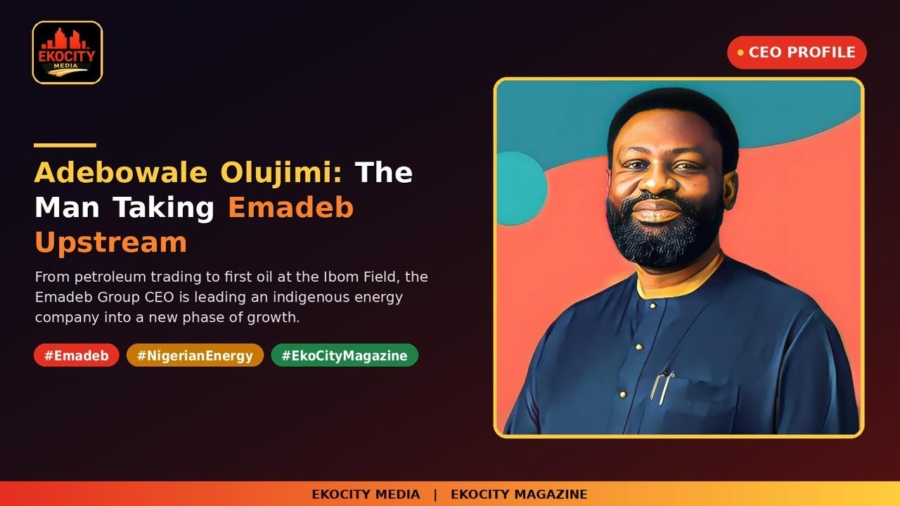
CEO of The Week: Adebowale Olujimi
The Energy Entrepreneur Taking Emadeb From Petroleum Trading to Oil Production
How the Group CEO of Emadeb Energy is steering an indigenous Nigerian business into a new phase of growth, with the Ibom Field marking a defining milestone in its upstream ambitions.
By Ekocity Business & Energy Desk
In Nigeria’s oil and gas industry, the journey from selling petroleum products to producing crude oil is a major business transition.
The downstream market demands commercial relationships, supply-chain efficiency, storage infrastructure and distribution networks. Upstream operations introduce another level of complexity: geological uncertainty, offshore engineering, substantial capital requirements, regulatory oversight and the challenge of turning an oilfield into a commercially sustainable asset.
For Adebowale Olujimi, Group Chief Executive Officer of Emadeb Energy Group, that transition represents a defining chapter in the company’s development.
His story is not simply about expanding a business. It is about an indigenous energy company seeking a larger role in the industry by moving from petroleum trading and distribution into exploration and production. And at the centre of that ambition is the Ibom Field.
The Man Behind The Emadeb Story
Olujimi’s professional background combines public-sector experience with entrepreneurship in Nigeria’s private energy market.
According to his official company profile, he studied Economics at the University of Lagos before building a career that led him into the petroleum industry. Emadeb credits his leadership with helping the group establish itself in downstream petroleum operations before pursuing opportunities in upstream oil and gas.
That progression matters in an industry where growth often depends on the ability to build relationships, understand market dynamics and deploy capital with discipline.
Emadeb’s evolution also reflects a broader opportunity for indigenous Nigerian companies: developing the technical, financial and organisational capabilities required to compete across more segments of the energy value chain.
Olujimi’s role has been to guide that strategic expansion while maintaining the commercial foundations on which the group was built.
From Petroleum Trading To An Integrated Energy Business
Emadeb’s origins were in petroleum-product trading, including products such as diesel, petrol and aviation fuel.
Over time, the group expanded into storage, distribution and other energy-related operations. In a May 2026 interview with Global Business Reports, Olujimi described a business that had grown from a relatively small trading operation into a company with activities spanning upstream, midstream and downstream segments.
The group’s infrastructure includes a major petroleum-products terminal in Lagos, which the interview described as having storage capacity approaching 70 million litres, as well as an LPG plant in Abuja that opened in 2021. This development offers a useful insight into Olujimi’s business strategy.
Rather than remaining confined to a single segment of the petroleum market, Emadeb has pursued a broader operating model intended to connect supply, storage, distribution and production.
Such integration can create commercial opportunities, but it also demands careful management. Each segment has distinct financing needs, operational risks and performance requirements.
The challenge is to ensure that expansion strengthens the business rather than stretching its resources too thinly.
Ibom Field: The Turning Point
The most significant milestone in Emadeb’s upstream journey came with the development of the Ibom Field, also known as PPL 236, offshore Akwa Ibom State.
The field was originally discovered in 1979. Emadeb acquired it through Nigeria’s 2020 marginal-field bid round and subsequently embarked on a phased development programme.
According to reports published by Premium Times and the News Agency of Nigeria, the company invested more than US$100 million in developing the field. The development involved drilling and completing the Ibom-03 well, integrating a Mobile Producing Offshore Unit and commissioning the field’s mooring system before first oil was achieved in October 2025.
For Emadeb, first oil was more than a corporate announcement. It marked the transition from developing an upstream asset to beginning commercial production.
The achievement also demonstrated the scale of the work required to bring a dormant offshore prospect into operation. The process involved engineering, investment, regulatory engagement and coordination among technical teams and commercial partners.
Olujimi described the milestone as evidence of what could be achieved through local expertise, collaboration and disciplined investment.
The accomplishment is significant, but the next stage is equally important: sustaining production, controlling costs and demonstrating that the field can deliver long-term commercial value.
The Capital, The Partnerships And The Patience
Oil production is rarely a story of individual achievement alone.
Behind a producing field are engineers, geoscientists, contractors, financial institutions, regulators, logistics providers and operational teams.
Emadeb’s development of the Ibom Field illustrates the importance of these relationships.
The company publicly acknowledged the support of Fidelity Bank in financing its upstream operations. In November 2025, Emadeb said its management presented first oil from the field to the bank’s leadership, recognising the role of financial support in advancing the project.
For indigenous operators, access to capital can be one of the biggest barriers to upstream development. Offshore projects require substantial investment before they generate revenue, while delays, technical difficulties and changes in market conditions can affect project economics.
Olujimi’s experience therefore offers a broader business lesson: ambition must be supported by financing, partnerships and the ability to execute over time.
In energy, a promising asset is only the beginning. Its value depends on whether a company can develop it safely, efficiently and commercially.
The Next Phase: Growing Production
Emadeb has outlined plans to expand production from the Ibom Field through additional drilling.
In its reporting on the field’s first oil, BusinessDay said the company planned a second development phase involving two additional wells, with the aim of tripling output by the fourth quarter of 2026. In May 2026, Global Business Reports reported that the company was targeting production above 12,000 barrels per day by year-end. These are stated development targets, not confirmation that the output level has already been achieved.
Achieving such an increase would require successful execution of the development programme, reliable infrastructure, effective reservoir management and appropriate financing. The company is also exploring opportunities to commercialise gas from its upstream operations, according to the May interview.
For Olujimi, this next phase will test whether Emadeb can translate its first production milestone into a larger and more sustainable upstream business. It will also help determine how much value the group can create from its investment in the field.
What His Journey Says About Indigenous Energy Leadership
Nigeria’s petroleum industry has historically been dominated by large international operators, although indigenous companies have progressively taken on greater responsibility for developing oil and gas assets.
The growth of local operators matters for several reasons: it can increase domestic participation in the energy sector, support local technical expertise, create employment and bring investment into assets that might otherwise remain undeveloped. But local ownership alone does not guarantee success.
Indigenous operators must meet the same demanding standards of operational safety, financial discipline, environmental responsibility and regulatory compliance required across the industry.
The Ibom Field therefore represents both an opportunity and a test.
For Emadeb, the objective is to sustain production and expand the asset responsibly. For the wider Nigerian industry, the project provides another example of the role local companies can play in developing the country’s petroleum resources.
Leadership Beyond The Headline
The story of Adebowale Olujimi is best understood through the business he has helped build and the strategic decisions behind its expansion.
The move from petroleum trading into upstream production requires a different scale of investment, a different technical capability and a longer horizon for returns.
Emadeb’s progress at the Ibom Field suggests that the group has moved beyond the planning stage of its upstream ambitions. Its next challenge is to establish a consistent record of production, operational performance and commercial value.
That is the distinction between entering a new market and building a durable position within it.
For Olujimi, the defining measure of leadership will not simply be the number of businesses or assets under the group’s umbrella. It will be the ability to make those businesses sustainable, create value for stakeholders and develop an organisation capable of competing in a demanding industry.
Ekocity CEO of The Week: The Verdict
Adebowale Olujimi’s business journey reflects a central question facing indigenous energy entrepreneurs in Nigeria:
Can a company built around petroleum trading and distribution successfully develop into a credible oil producer?
Emadeb’s achievement of first oil at the Ibom Field represents a significant step towards answering that question.
The investment, technical development and partnerships behind the project show the scale of the undertaking. The company’s planned expansion will now test its ability to sustain production and turn its upstream ambitions into measurable results.
For Nigeria, the stakes extend beyond one company. The growth of capable indigenous operators can contribute to investment, local technical development and the responsible exploitation of domestic energy resources.
For Olujimi, the next chapter is about execution. The oilfield is producing. The expansion plans have been outlined. The commercial challenge is to build on that foundation.
In the energy business, ambition opens the door. Capital makes development possible. But sustained performance is what builds a legacy.
— Ekocity Business & Energy Desk

Fawumi Kayode Abiodun
Political Analyst | CEO, Ekocity Media | Publisher, Ekocity Magazine and The Capitol Post
Add a Comment