

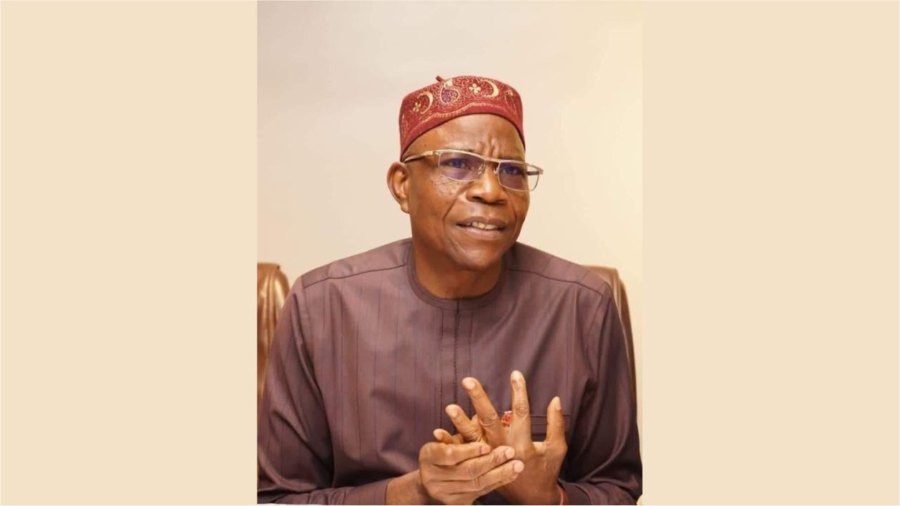
LAGOS APC: WHAT EXACTLY EARNED PASTOR CORNELIUS OJELABI ANOTHER FOUR YEARS?
The recent re-election of Cornelius Ojelabi as chairman of the All Progressives Congress (APC) in Lagos State has quietly sparked conversations within the state’s political landscape.
In a political environment as complex and layered as Lagos, leadership continuity within a ruling party is rarely accidental. It often reflects deeper calculations about power balance, loyalty, and electoral strategy.
But the question many political observers are asking is straightforward: what exactly earned Pastor Cornelius Ojelabi another four-year mandate?
During his tenure as party chairman, Lagos APC navigated one of the most politically turbulent periods in recent memory — the 2023 general elections. The elections tested the party’s traditional dominance in Lagos as opposition forces gained unprecedented traction, particularly during the presidential contest.
Despite the strong surge of opposition support across parts of the state, the APC ultimately retained control of the governorship through the re-election of Babajide Sanwo-Olu. The party also maintained considerable influence across legislative structures in the state.
From an internal party perspective, holding on to power during a challenging electoral cycle can be interpreted as a successful defense of political ground.
However, electoral outcomes alone rarely define leadership longevity within Lagos’ political architecture. The state’s party structure has long operated within a highly organized system historically associated with Bola Ahmed Tinubu, whose political influence has shaped the strategic direction of the APC in Lagos for decades.
Within such a system, party leadership is often evaluated not only on public visibility or populist appeal but also on the ability to maintain internal cohesion among various political blocs, manage competing interests, and sustain the grassroots party machinery that drives electoral mobilization.
Observers note that Pastor Ojelabi’s leadership style has largely been administrative and conciliatory, focusing on maintaining party unity across ward, local government, and senatorial district structures. In a party as expansive as Lagos APC, preventing internal fragmentation can be as important as winning elections.
Another factor may simply be political timing. With upcoming local government elections and early positioning toward the 2027 national political cycle already underway, continuity within the party leadership could be seen as a safer strategic choice than introducing a new chairman who might disrupt existing alignments.
Yet, the development still raises broader questions about how political performance is measured within party systems.
Is leadership renewal driven primarily by electoral outcomes?
Is loyalty to the political establishment the most decisive factor?
Or is stability within the party structure the ultimate currency of political survival?
These are questions that continue to shape not just the future of the APC in Lagos but the broader evolution of party politics in Nigeria.
As Lagos moves toward the next phase of its political journey, the re-election of Pastor Cornelius Ojelabi offers a moment to reflect on how power, performance, and political structure intersect within the state’s ruling party.
For observers and citizens alike, the conversation is far from over.

Fawumi Kayode Abiodun
Political Analyst | CEO, Ekocity Media | Publisher, Ekocity Magazine and The Capitol Post
Add a Comment