

Aisha Buhari’s Visit to Atiku: A Courtesy Call, a Political Signal — or Something More?
The former First Lady’s meeting with the 2027 ADC presidential candidate arrives at a politically sensitive moment, but neither side has attached a campaign meaning to it.
Exclusive to Ekocity | Politics & Governance Desk
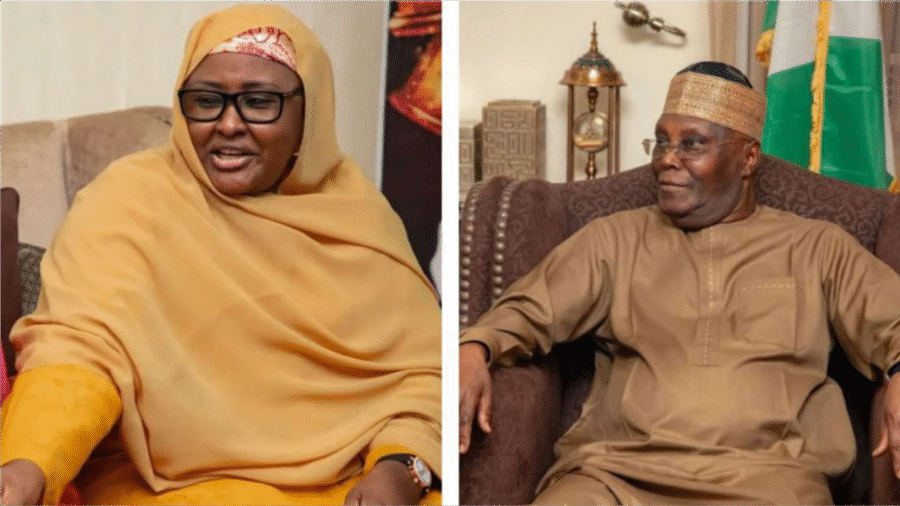
ABUJA — A photograph can sometimes say more than a political statement. This week, images of former First Lady Aisha Buhari visiting former Vice-President Atiku Abubakar, the 2027 presidential candidate of the African Democratic Congress (ADC), immediately drew attention across Nigeria’s political landscape.
Atiku disclosed the meeting on his social-media platforms, describing Aisha Buhari’s visit as “warm and deeply appreciated.” He did not, however, say that the meeting was about the 2027 election, nor did either side announce a political agreement or endorsement. That distinction matters. Yet politics rarely treats prominent meetings as merely social occasions — particularly in the months before a presidential election.
A Meeting Loaded With Political History
Aisha Buhari is not simply a former First Lady. She is the widow of the late President Muhammadu Buhari, whose political legacy remains significant, particularly across northern Nigeria.
Atiku, meanwhile, is preparing for another presidential contest, this time under the ADC banner after years as one of the country’s most prominent opposition figures. Their meeting therefore carries a political context even though its specific purpose remains undisclosed.
Reports say Aisha was accompanied by one of her daughters and associates. Neither she nor Atiku has publicly suggested that the visit represents an endorsement of his presidential campaign. For now, anything beyond that would be speculation. But the timing inevitably invites questions.
Atiku Chooses The Economy
Following the meeting, Atiku focused his public message not on electoral arithmetic but on Nigeria’s economic difficulties. He highlighted the pressure facing families over food, transportation, education, healthcare and other basic necessities.
His political message was familiar: Nigerians need an economy that rewards hard work, restores opportunity and allows families to live with dignity. He concluded with the phrase “Make Nigeria Affordable Again.”
It was a carefully chosen response to a politically sensitive encounter. Rather than allowing the photograph to become solely about personalities, Atiku used the moment to reinforce one of the central themes of his emerging 2027 campaign — the cost of living.
What Does Aisha’a Visit Mean?
That is the question now hanging over Abuja. Does it represent a personal relationship between two senior political figures? Was it simply a private courtesy visit?
Was it part of broader consultations taking place ahead of 2027? Or could it eventually develop into something politically more consequential? At present, there is no public evidence to establish the latter. And that is precisely why the meeting is interesting.
In Nigerian politics, political movements often begin quietly — through conversations, consultations and relationships long before formal announcements are made. But equally, not every political meeting produces an alliance.
The 2027 Calculation
For Atiku and the ADC, the importance of northern political relationships cannot be ignored. The former Vice-President will need to build a coalition capable of competing against the governing APC, while also navigating the ambitions of other opposition figures and parties.
Aisha Buhari, for her part, has not publicly declared support for Atiku in connection with this visit. So the photograph should not yet be mistaken for a campaign endorsement.
But it has unquestionably generated political conversation. And in an election that is already beginning to take shape, conversation itself has value. For now, the meeting remains officially what Atiku described it to be: a warm and appreciated visit.
The political class, however, will continue watching. Because as Nigeria moves toward 2027, who speaks to whom — and when — can sometimes become as important as what they say publicly.

Fawumi Kayode Abiodun
Political Analyst | CEO, Ekocity Media | Publisher, Ekocity Magazine and The Capitol Post
Add a Comment