

Dangote’s Succession Moment: “My Daughters Can Take the Empire Further”
Exclusive to Ekocity | By Ekocity Business & Leadership Desk
For decades, one question has quietly followed Africa’s most successful industrialist: What happens to the Dangote empire when Aliko Dangote is no longer at the centre of it? On Tuesday, that question moved from boardrooms and business conferences into the national conversation.
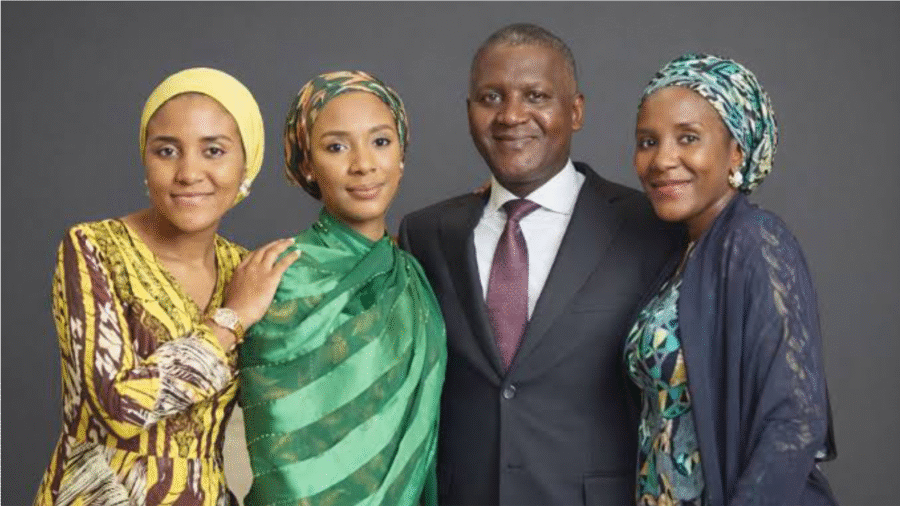
In an exclusive interview with ARISE News anchor Ojy Okpe, Dangote offered one of his clearest public statements yet about succession, saying he could see one of his three daughters eventually leading the multibillion-dollar conglomerate.
“I think, yes, I can see one of them,” Dangote said, adding that he had been watching all three and believed any one of them could lead.
His message went further. Dangote said his daughters — Halima, Fatima and Mariya — are deeply interested in the business and are participating because they want to, rather than because their father is forcing them into the family enterprise.
He also suggested that they could eventually surpass what he has achieved. That statement carries particular weight because this is no longer a family business operating on the scale of a traditional Nigerian conglomerate.
The Dangote Group now spans cement, sugar, food, fertiliser, oil and gas, refining, petrochemicals and other industrial interests, with operations extending beyond Nigeria. Its flagship refinery is currently at the centre of Africa’s largest-ever IPO, while the group is pursuing an ambitious $100 billion enterprise vision.
Three Daughters, Three Strategic Roles
The succession conversation is not starting from zero. Earlier this year, the Dangote Group expanded the responsibilities of the three daughters. Fatima Dangote was appointed Group Executive Director, Commercial Operations — Oil & Gas, with responsibilities spanning the refinery, fertiliser and upstream interests.
Mariya Dangote was given responsibility for Commercial Operations covering the cement and food businesses.
Halima Dangote was appointed Group Executive Director, Family Office & International Offices, overseeing the Dubai and London operations.
The structure suggests something more sophisticated than simply preparing “the children” to inherit assets. It is about building a leadership pipeline.
The Son Question
Perhaps the most striking part of Dangote’s interview was his response to the traditional expectation of a male heir.
He said having a son was not his priority, arguing that being male does not automatically make someone capable of preserving a family’s legacy.
He went as far as saying that, even if he had a son, he did not believe that son would necessarily have done better than his three daughters.
That statement challenges a deeply rooted assumption in many African family businesses: that succession must ultimately pass through a male heir.
Dangote’s position is essentially different: Competence should matter more than gender. But Dangote Says It Must Be Bigger Than Family.
Perhaps the most important part of his remarks was not about his daughters at all.
Dangote said he wants the company to be professionally run and governed, pointing to companies such as Microsoft and Apple as examples of institutions capable of surviving their founders. That distinction matters. A family can inherit wealth. But an institution must earn continuity.
If the Dangote Group is eventually to become a truly multigenerational African industrial institution, its future cannot depend solely on the Dangote surname.
It will require strong boards, professional managers, transparent governance, succession systems and a culture capable of attracting talent beyond the family.
Dangote’s broader ambition is even larger. He said his desired legacy is to industrialise Africa, acknowledging that such a mission cannot be accomplished by one individual alone.
And perhaps that is the real story behind today’s headline. This is not simply about three daughters potentially inheriting Africa’s biggest business empire.
It is about whether Aliko Dangote can successfully transform a personal entrepreneurial achievement into an institution capable of influencing Africa for generations.
The empire was built by one man. The next chapter may be written by his daughters — but its survival will ultimately depend on the strength of the institution they inherit.

Fawumi Kayode Abiodun
Political Analyst | CEO, Ekocity Media | Publisher, Ekocity Magazine and The Capitol Post
Add a Comment