

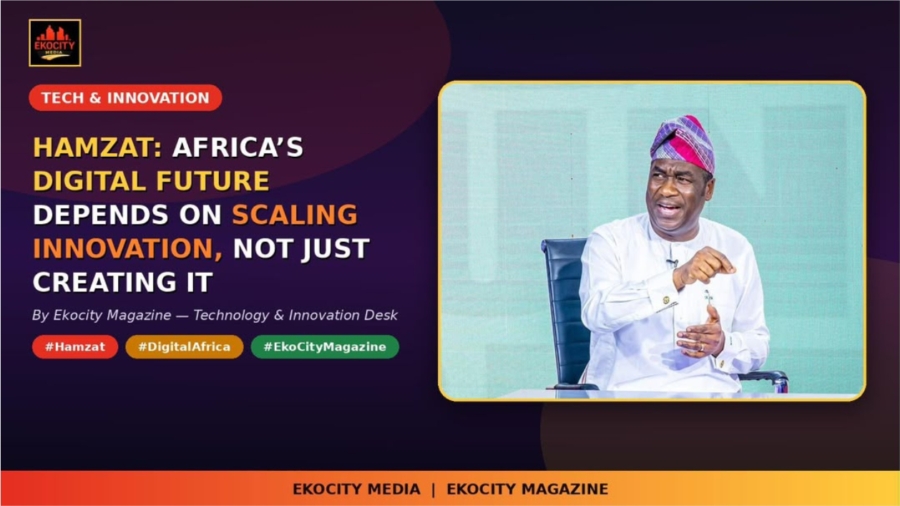
Hamzat: Africa’s Digital Future Depends on Scaling Innovation, Not Just Creating It
Lagos Deputy Governor calls for stronger digital infrastructure, predictable policies and sustained investment to turn African technological breakthroughs into solutions that reach millions.
LAGOS, Nigeria — Africa’s digital transformation will depend less on how many innovations the continent produces than on its ability to turn promising ideas into sustainable systems that improve lives, expand economic opportunities and serve millions of people.
That was the central message from Lagos State Deputy Governor, Dr. Kadri Obafemi Hamzat, at the fifth edition of TeXcellence, organised by CWG Plc on Tuesday at the Landmark Event Centre in Lagos.
Addressing technology leaders, policymakers and other industry stakeholders, Hamzat argued that Africa’s principal technology challenge is no longer a shortage of ideas. Rather, it is the difficulty of scaling successful innovations beyond isolated achievements into solutions with lasting economic and social impact.
“Africa does not have an innovation problem. We have a scaling problem. And scale is a systems question,” he said.
The distinction carries significant implications for governments across the continent, where entrepreneurs, researchers and technology companies are developing solutions to challenges ranging from public service delivery to financial inclusion and infrastructure management.
For Hamzat, the missing link is an enabling environment capable of supporting these innovations beyond their initial stages.
“The distance between a good idea and a system that works for millions — that is where government lives,” he said.
Government As An Enabler Of Technology
Speaking on the theme of his address, “The Enabling State: What Government Must Become for Technology to Scale,” Hamzat called for a shift in how governments approach technological development.
Rather than concentrating primarily on regulation, he said, governments must help create the conditions under which technology businesses can develop, grow and remain sustainable.
That requires investment in shared digital infrastructure, consistent policies, research and development, and institutions that can sustain technological progress beyond individual political administrations.
He also called for the removal of bureaucratic obstacles that prevent promising innovations from reaching wider markets, arguing that government support must extend beyond encouraging entrepreneurs to building systems that allow their solutions to endure.
The broader challenge, he suggested, is to ensure that African innovation becomes an engine of economic development rather than a collection of disconnected success stories.
Lagos’ Digital Infrastructure Push
Hamzat pointed to Lagos State’s investments in digital infrastructure and public service reforms as examples of efforts to establish the foundations for wider technology adoption.
According to the deputy governor, approximately 3,000 kilometres of fibre ducts and networks have been laid across the state, with a further $22 million invested towards developing a unified 6,000-kilometre network.
He also disclosed that more than 6.4 million residents had been enrolled in the state’s resident identity system, while digital reforms had streamlined selected public services, including physical planning permits and mortgage consent processing.
Such infrastructure is increasingly important to cities like Lagos, where population growth, commercial activity and demand for efficient public services place considerable pressure on government institutions.
Reliable connectivity and accessible digital identity systems can support more efficient service delivery, improve access to digital services and create opportunities for businesses to reach customers across different parts of the economy.
However, the wider value of these investments will depend on how effectively the infrastructure is deployed, maintained and translated into services that residents and businesses can readily use.
Funding The Next Generation Of African Innovators
The deputy governor also highlighted the role of research, development and early-stage financing in building a sustainable technology ecosystem.
He said the Lagos State Science Research and Innovation Council (LASRIC) had supported 80 researchers and more than 75 startups, with approximately ₦1 billion available in grants for innovators.
Hamzat further disclosed that the state was considering an innovation law that would commit a fixed proportion of its annual budget to research, development and risk capital.
If adopted, such a framework could provide a more structured approach to funding local innovation, helping businesses and researchers plan beyond short-term grants and pursue solutions with longer development cycles.
The proposal also raises a broader policy question for African governments: how can public funding be structured to support innovation consistently while encouraging private investment, commercial viability and measurable results?
Hamzat called for stronger collaboration between government and industry, proposing measurable commitments from both sides to accelerate digital transformation.
African’s Digital Sovereignty Question
In his welcome address, Adewale Adeyipo, Group Managing Director and Chief Executive Officer of CWG Plc, described TeXcellence as a platform that had evolved over five years into a strategic forum for shaping Africa’s digital future.
Adeyipo urged governments, technology companies and other stakeholders to prioritise digital sovereignty, local artificial intelligence infrastructure and the sustainable deployment of technology.
For him, the continent must move beyond experimenting with emerging technologies and focus on developing and deploying solutions that strengthen Africa’s control over its technological future.
He called for deliberate investment in local computing infrastructure, wider access to affordable digital devices and improved digital literacy.
He also emphasised the need to move artificial intelligence solutions beyond pilot programmes into dependable systems capable of delivering commercial value and addressing practical challenges.
The argument reflects a growing concern about Africa’s position in the global digital economy: adopting technologies developed elsewhere may accelerate access to new capabilities, but building local capacity remains essential to shaping how those technologies are developed, deployed and used.
For African economies, the task is therefore not simply to participate in the digital revolution, but to develop the infrastructure, skills and institutions needed to capture more of its economic value.
From Digital Ambition To Measurable Results
The messages from Hamzat and Adeyipo converged on a common challenge: Africa’s digital future will require more than technological enthusiasm.
It will demand sustained investment, policies that businesses can rely on, institutions capable of supporting long-term development and partnerships that translate innovation into practical outcomes.
For Lagos, the challenge is particularly significant. As one of Africa’s major commercial centres, the state has an opportunity to demonstrate how digital infrastructure, research funding and public sector reform can support a more productive urban economy.
But the ultimate measure of progress will not be the number of technologies introduced or the scale of investment announced. It will be whether businesses become more competitive, public services become more accessible and innovations reach the people who need them.
At TeXcellence, the message was clear: Africa has ideas. Its next challenge is building the systems that allow those ideas to scale.

Amb. Fawumi Kayode Abiodun
Publisher, Ekocity Media | Business, Cities, Leadership and Public Policy
Add a Comment