

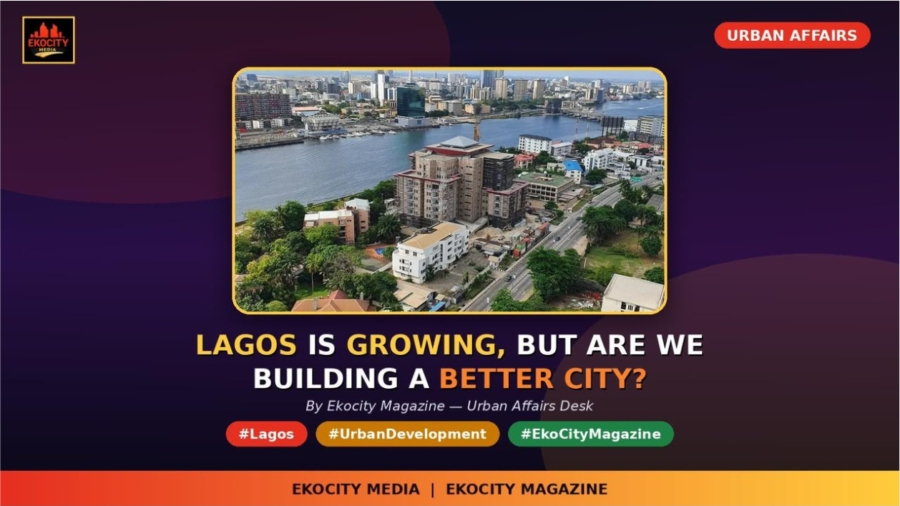
Lagos Is Growing, But Are We Building a Better City?
As Lagos expands its skyline and pursues new infrastructure, the real measure of urban development must be how effectively the city serves the people who live and work in it.
By Amb. Fawumi Kayode Abiodun | The Publisher’s Desk
Lagos is a city that rarely stands still. From the expanding skyline of Victoria Island and Lekki to the busy commercial districts of Ikeja, the mainland and emerging communities along the Lagos corridor, the signs of development are everywhere. New residential estates are rising, commercial buildings are reshaping neighbourhoods, and infrastructure projects continue to influence how people move, work and invest.
For investors, developers and entrepreneurs, Lagos remains a compelling centre of economic activity. For millions of residents, however, the experience of living in the city raises a more fundamental question: as Lagos grows, is it becoming a better place to live?
It is a question worth asking, not to diminish the progress being made, but to examine what development should ultimately deliver.
A city is not defined by the height of its buildings alone. Its success must also be measured by the quality of life it provides, the opportunities it creates, the resilience of its infrastructure and its ability to accommodate people across different income levels.
The Skyline And The Street
Real estate development has become an unmistakable feature of Lagos. Luxury apartments, gated estates, commercial towers and mixed-use developments continue to change the urban landscape, particularly across parts of the Lekki–Epe corridor.
This investment is significant. It can generate employment, attract capital, stimulate demand for professional services and contribute to economic activity.
Yet the growth of premium property developments also presents an important policy question: how does a city accommodate the housing needs of its broader population while encouraging private investment?
For many households, access to housing is not simply a question of finding a suitable property. It involves balancing rent, transportation, food, education and other essential expenses.
A housing market can attract substantial investment while remaining inaccessible to large sections of the population.
The answer is not to discourage development. It is to encourage a broader range of housing options, strengthen the supply of affordable homes, improve access to housing finance and ensure that planning policies reflect the needs of different income groups.
Developers, financial institutions and government must recognise that a successful housing market should serve more than one segment of society.
The objective should be a city where investment can prosper without making adequate housing increasingly difficult to attain.
Mobility Is Part Of The Quality Of Life
In Lagos, distance is not measured in kilometres alone. It is also measured in the time people spend travelling between their homes, workplaces, schools and businesses.
For workers who live far from their places of employment, commuting can consume valuable hours and impose additional financial costs. Traffic congestion affects productivity, family life and the movement of goods and services.
Transport infrastructure is therefore not merely an engineering consideration. It is an economic and social necessity.
The expansion and integration of public transport, including rail, buses and waterways where appropriate, should remain central to the city’s development priorities.
However, transport investments must connect with how people actually live and work. Reliable feeder services, safer pedestrian routes, better connections between transport modes and coordinated land-use planning can help make infrastructure more useful.
The relationship between housing and transportation also deserves greater attention.
When affordable homes are located far from employment centres, households may pay less in rent but more in commuting costs and lost time. Urban planning should consider these costs together rather than treating housing and mobility as separate problems.
A better-connected Lagos would benefit not only commuters but also businesses that depend on employees, customers and efficient logistics.
Flooding, Drainage And The Question Of Resilience
Flooding remains another major challenge facing Lagos and other rapidly urbanising coastal cities.
Heavy rainfall, inadequate drainage in some locations, blocked waterways, development patterns and the city’s coastal geography all complicate the challenge. The relative contribution of these factors varies by location, which makes reliable local assessments essential.
The consequences can be severe for households, businesses, road users and communities whose homes or livelihoods are affected.
For property owners and investors, flooding also raises questions about asset protection, insurance, construction standards and long-term value.
The response must extend beyond emergency interventions after heavy rainfall.
Lagos needs sustained investment in drainage maintenance, improved waste management, flood-risk mapping, enforcement of appropriate building and planning standards, and protection of waterways and other natural drainage systems.
New developments should be assessed against the environmental conditions of their locations. Drainage infrastructure must be designed, maintained and coordinated with surrounding communities rather than treated as an isolated feature of individual estates.
Government agencies, developers, residents and waste-management operators all have responsibilities in this process.
A resilient city is not one that promises to eliminate every flood. It is one that systematically reduces preventable risks, prepares for severe weather and protects vulnerable communities.
Development Must Be Measured By Outcomes
The challenge before Lagos is not simply to build more. It is to ensure that development produces measurable public value. Every major infrastructure project should be assessed against clear questions.
What problem is it intended to solve? Who benefits from it? How many people can access its services? What are the maintenance requirements? How does it affect surrounding communities? Is the investment delivering the outcomes originally promised?
These questions should form part of a wider culture of transparent planning and performance measurement.
Government has a responsibility to establish clear development priorities, publish relevant information and coordinate infrastructure across agencies and jurisdictions.
Private developers must comply with applicable building and planning requirements and consider how their projects affect the wider urban environment.
Residents also have a role to play through responsible waste disposal, protection of public spaces and participation in local planning discussions.
No single institution can build a better Lagos in isolation.
The city requires sustained cooperation between public authorities, the private sector, professional institutions, community organisations and the people whose lives are shaped by development decisions.
A Different Conversation About Lagos
Perhaps the most important shift required is in how we discuss the future of Lagos.
Too often, urban development is presented through individual projects, impressive buildings, investment announcements and ceremonial milestones.
These are legitimate subjects for coverage, but they are only part of the story.
We must also examine whether residents can access decent housing, whether journeys are becoming more manageable, whether neighbourhoods are better protected against flooding, whether public infrastructure is properly maintained and whether economic opportunities are accessible to a wider population.
These are not arguments against investment or development. They are questions about what investment and development should achieve.
Lagos has the economic activity, entrepreneurial energy and professional expertise to continue evolving. The task is to connect that dynamism with long-term planning, infrastructure resilience and a more inclusive approach to urban growth.
For policymakers, this means placing measurable outcomes at the centre of public decisions. For investors and developers, it means recognising that successful projects depend partly on the strength and sustainability of the wider city. For residents, it means demanding transparency, participating in civic processes and taking shared responsibility for the urban environment.
The future of Lagos will not be determined by buildings alone. It will also be shaped by the decisions that connect those buildings to transport, services, jobs, public spaces and functioning communities.
As a city, Lagos must continue to grow. But growth should be a means to an end, not the final measure of success.
The real question is not simply how much Lagos can build. It is how well Lagos can work for the people who call it home.
That is the conversation our city deserves, and one that must continue long after the next building is completed or the next infrastructure project is commissioned.
Amb. Fawumi Kayode Abiodun is the Publisher of Ekocity Media. The views expressed in this column are his own.

Amb. Fawumi Kayode Abiodun
Publisher, Ekocity Media | Business, Cities, Leadership and Public Policy
Add a Comment