

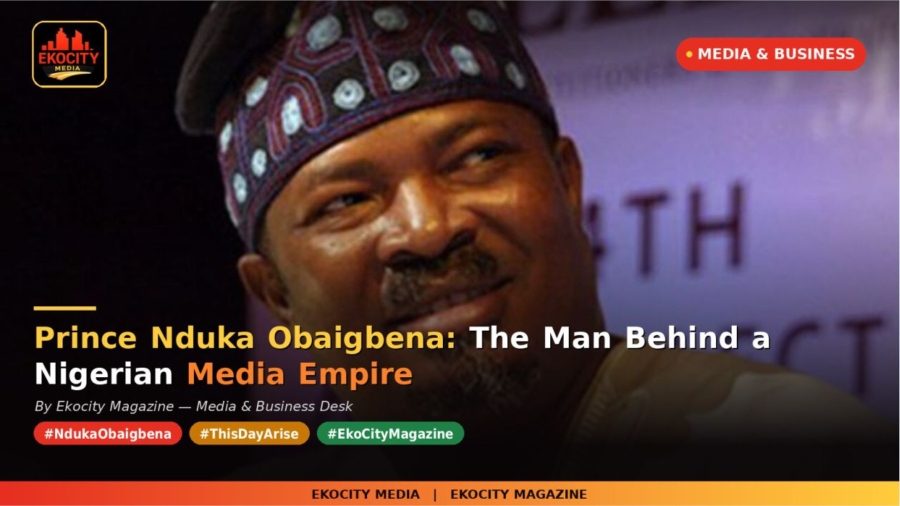
Prince Nduka Obaigbena: The Man Behind a Nigerian Media Empire
By Ekocity Magazine — Media & Business Desk
There are Nigerian entrepreneurs who build companies, and there are those who build institutions. Prince Nduka Obaigbena belongs to the second category. For almost five decades, Obaigbena has operated at the intersection of journalism, business, politics, entertainment, fashion and technology, building a media ecosystem that has helped shape how Nigeria sees itself — and how the world sees Nigeria.
His journey began in journalism. After attending Edo College and the University of Benin, he pursued further management education in South Africa. In 1986, at just 27, he founded ThisWeek magazine. Nine years later came THISDAY, which would become one of Nigeria’s most influential newspaper brands.
Building THISDAY
The significance of THISDAY was not simply that another newspaper entered the market. Obaigbena challenged conventions in Nigerian newspaper publishing. The paper became known for its distinctive visual presentation, extensive business coverage and willingness to give prominent space to opinion writers.
The DAME Awards notes that THISDAY helped popularise practices including prominent columnist placement, publication of detailed stock-market transactions and colour newspaper production.
The business strategy was broader than selling newspapers. Obaigbena understood that a media company could build influence through events, personalities, advertising, awards, lifestyle and access.
The THISDAY Awards became an annual platform recognising influential figures across politics, business, education and society. In effect, he transformed a newspaper brand into an ecosystem.
From Print to Television
The next major chapter was ARISE News. Launched as an international television news channel with an African focus, ARISE was designed to give African stories a global platform. The channel developed operations connecting Lagos with international media centres including London, New York and Johannesburg. That expansion was strategically important.
Rather than waiting for international broadcasters to decide which African stories deserved attention, Obaigbena built a platform through which African politics, business, culture and personalities could be presented directly to international audiences.
Today, ARISE’s political interviews and programmes such as The Morning Show have become part of Nigeria’s daily public conversation.
Beyond News: Fashion and the Creative Economy
Obaigbena’s empire also moved into the creative industries. Through ARISE Magazine and ARISE Fashion Week, he invested in African designers and created platforms that connected Nigerian fashion with international audiences. The fashion initiative has staged events in cities including London, Johannesburg, Cape Town, New York, Paris and Lagos. This was more than fashion entertainment.
It reflected a broader commercial thesis: African creativity could become an export industry if it was given the infrastructure, visibility and international platforms required to attract capital and consumers.
That philosophy remains relevant as Nigeria increasingly looks to its creative economy as an alternative source of jobs, foreign exchange and global influence.
The Talent Factory
Perhaps less visible than the buildings, television screens and newspaper pages is Obaigbena’s contribution to human capital.
THISDAY became a training ground for generations of Nigerian journalists, editors, writers and media executives. Industry recognition of his career repeatedly highlights his role in identifying and developing talent.
This may ultimately prove to be one of his most durable legacies. Companies disappear. Technologies become obsolete. Newspapers change format. But people who have been trained, mentored and given opportunities carry institutional knowledge into the next generation.
Influence Beyond Business
Obaigbena’s influence has also extended into the professional organisation of Nigerian journalism. He served as president of the Newspaper Proprietors’ Association of Nigeria (NPAN) and later became a life patron of the association. He also chaired the Nigerian Press Organisation, bringing together the NPAN, Nigerian Union of Journalists and Nigerian Guild of Editors.
He has also participated in international business and policy conversations, including the World Economic Forum, while using his platforms to bring prominent global figures into Nigerian public discourse.
The Complicated Side of the Empire
But a serious examination of Obaigbena cannot be reduced to awards and achievements. Like many large media businesses operating in Nigeria and internationally, his enterprises have faced financial, operational and governance controversies.
A UK court in 2021 disqualified him from acting as a company director for seven years in connection with the collapse of an ARISE-related company and findings concerning its management.
Those issues form part of the public record and are important when assessing the risks involved in building ambitious media institutions. Yet they do not erase the scale of what was built.
They demonstrate instead the difficult balance between ambition, capital, governance, expansion and sustainability that confronts entrepreneurs operating large media businesses.
The Next Generation of the Empire
Obaigbena’s strategy is now moving further into digital media. In 2026, he launched LekeeLekee, a social-media platform that ARISE reported had surpassed 100,000 downloads within its first six months.
The move is significant because the traditional media business is undergoing a structural transformation. Newspapers compete with smartphones; television competes with streaming; advertising is moving toward digital platforms; and audiences increasingly consume information through social networks.
For an entrepreneur whose career began in print journalism, the move into social media represents another attempt to remain ahead of the technological curve.
Recognition in 2026
In September 2026, LEADERSHIP named Obaigbena its Person of the Year 2026, recognising what it described as his contribution to institution-building, talent development, innovation, investment and job creation.
The recognition comes almost four decades after he launched ThisWeek. That longevity may be the most revealing part of his story. Obaigbena has repeatedly moved from one media technology to another — magazine, newspaper, television, fashion, events and now digital platforms.
What Entrepreneurs Can Learn
There are several lessons in the Obaigbena model.
First: build platforms, not just products. A newspaper became an events brand; the media brand became television; television became a platform for politics, business and culture.
Second: talent is infrastructure. The strongest institutions are built by people capable of carrying the vision beyond the founder.
Third: own the narrative. Obaigbena consistently invested in platforms capable of telling Nigerian and African stories from an African perspective.
Fourth: keep evolving. The move from print to television and now digital technology demonstrates an understanding that media businesses survive by adapting to where audiences are going.
And finally, ambition must be matched by governance. Building a large institution requires financial discipline, transparent structures and the ability to manage growth without allowing expansion to outrun the underlying business.
Prince Nduka Obaigbena’s story is therefore bigger than THISDAY or ARISE. It is a story about an entrepreneur who recognised early that media is not merely about information; it is about influence, culture, talent, access and economic power.
From a young publisher launching ThisWeek in 1986 to the architect of a multinational African media brand, his career offers one of Nigeria’s most instructive examples of how journalism can become an entrepreneurial institution.
And perhaps the most enduring part of his legacy is not the newspaper or television channel. It is the generations of Nigerians who found a platform, a profession and a voice through the institutions he built.

Fawumi Kayode Abiodun
Political Analyst | CEO, Ekocity Media | Publisher, Ekocity Magazine and The Capitol Post
Add a Comment