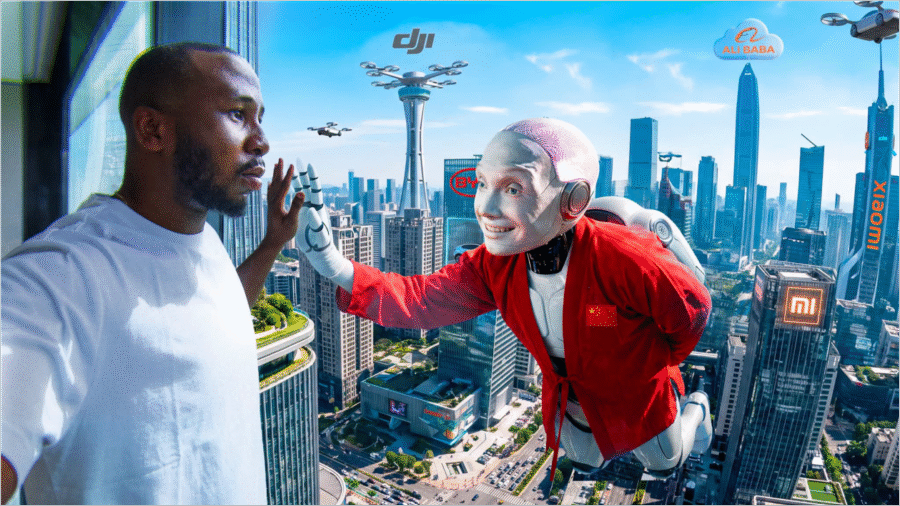



Steven Ndukwu 3

Steven Ndukwu in China: The Nigeria Question Behind His ‘2050’ Experience

Steven Ndukwu in China: The Nigeria Question Behind His ‘2050’ Experience

Exclusive to Ekocity | By Ekocity Technology & Business Desk

What happens when a Nigerian creator walks into a country that appears to be operating several decades ahead of his expectations?
For Nigerian filmmaker and digital creator Steven Ndukwu, that is the central experience of his ongoing journey through China. Through videos and social media updates, Ndukwu has been documenting the country beyond the familiar tourist attractions, showing viewers the inner workings of its rapidly developing technological and industrial ecosystem.

His observations have generated a conversation that reaches far beyond travel. It is, at its core, a conversation about Nigeria’s future.
In his documentation, Ndukwu has drawn attention to China’s cashless transactions, electric vehicles, advanced infrastructure, robotics, artificial intelligence and highly organised urban environments — at one point describing the experience as looking like “2050.”

The phrase may be dramatic, but the underlying question is serious: how did China move from developing-country status to becoming one of the world’s most important manufacturing and technology powers?

China Is More Than Skyscrapers
The most important lesson from Ndukwu’s journey is that China’s transformation cannot be explained by impressive buildings or modern trains alone. It is an industrial story.

China spent decades building manufacturing capacity, infrastructure, technical skills, supply chains and domestic markets. Technology was integrated into everyday economic activity — from payments and transportation to manufacturing and logistics — creating a powerful ecosystem.

A Chinese electric vehicle, for example, is not simply a car: behind it stand battery manufacturers, software developers, semiconductor suppliers, charging infrastructure, engineers, logistics companies and financing systems. That is industrialisation.

And Then Comes the Nigeria Question
Nigeria possesses many of the ingredients required for transformation: a huge population, abundant natural resources, entrepreneurial citizens, energy resources and a strategically important African market. Yet the country continues to struggle with electricity reliability, transportation infrastructure, manufacturing costs, technological capacity and inconsistent industrial policies.

This is where Ndukwu’s Chinese journey becomes relevant to the Nigerian conversation. The lesson should not be “copy China.” It should be: understand how China built systems that allow businesses, technology and infrastructure to reinforce one another. Nigeria needs to move from importing finished products to developing stronger domestic value chains.

The AI and Robotics Challenge
Perhaps the most consequential part of the Chinese experience is the speed at which automation and artificial intelligence are entering everyday economic life.
For Africa, this presents both an opportunity and a warning. AI can improve healthcare, agriculture, security, education, financial services and public administration; robotics can transform manufacturing, logistics, construction and industrial operations. But countries that fail to invest in skills, electricity, computing infrastructure and local technology businesses risk becoming permanent consumers of technologies developed elsewhere.

A Journey Bigger Than Travel
Steven Ndukwu’s China documentation is therefore more than a travel series. It is an invitation to look at Nigeria from another perspective. The real question is not whether China looks like 2050.

The real question is: what must Nigeria begin doing today if it wants its own 2050 to look fundamentally different from its present?
That is the conversation worth having.

Ekocity Technology & Business Desk — September 15, 2026



Fawumi Kayode Abiodun

Political Analyst | CEO, Ekocity Media | Publisher, Ekocity Magazine and The Capitol Post

Add a Comment

Your email address will not be published. Required fields are marked *