

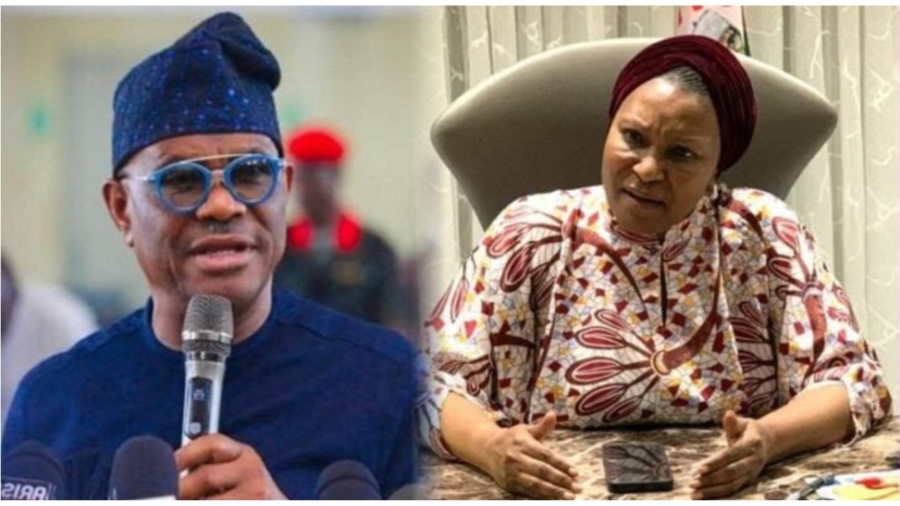
Wike vs Kingibe: Abuja’s Political Fault Line Deepens Over Loans, Accountability and 2027
By Ekocity Politics Desk
The latest confrontation between Nyesom Wike, the Minister of the Federal Capital Territory, and Senator Ireti Kingibe is no longer merely another quarrel between two politicians who have struggled to work together It is becoming a larger argument about power, accountability and the limits of political authority in Abuja. At the centre of the latest dispute is money. Kingibe, the senator representing the Federal Capital Territory, has questioned the borrowing undertaken by the FCT Administration, alleging that loans were obtained without the required approval of the National Assembly. She said she had raised the issue with the Senate leadership and argued that she had not seen Wike appear before the Senate to seek approval for such borrowing. (TheCable)
Wike has rejected the allegation. During an inspection of ongoing road projects in Abuja on Tuesday, the minister argued that government borrowing is incorporated into the budget and subjected to legislative approval. He dismissed Kingibe’s interpretation of the process and went further, questioning her understanding of government finance.
He also revived a political question that has shadowed their relationship for more than two years: whether Kingibe will return to the Senate after the 2027 elections.
Wike said she would not.
The minister has repeatedly argued that Kingibe has little to show in terms of projects and representation and has openly backed former senator Philip Aduda as a political alternative in the FCT. (TheCable)
Kingibe’s response has been equally direct. Rather than allowing the argument to become a contest of personalities, she has attempted to move the dispute back to documentation.
Her challenge to Wike is simple: produce the Senate’s official Votes and Proceedings showing when the chamber approved the loans in question. That is an important distinction. In a functioning democracy, the question is not necessarily whether a minister is popular or whether a senator is politically influential. The question is whether public money has been borrowed and spent according to the law.
Kingibe has insisted that scrutinising government borrowing is part of her responsibility as a legislator. She has also rejected the suggestion that Wike can determine her political future, arguing that it is ultimately the voters of the FCT who will decide who represents them in 2027. (TheCable)
The dispute exposes a deeper tension in the governance of the Federal Capital Territory. Unlike a conventional state, the FCT occupies a peculiar constitutional position. The President exercises executive authority over the territory, while the minister functions as the administrative head. At the same time, the FCT has elected representatives in the National Assembly whose responsibilities include legislation and oversight.
That arrangement can produce friction when an appointed minister and elected legislators disagree over development priorities, spending or accountability. And Abuja has seen plenty of that friction.
Kingibe and Wike have disagreed over infrastructure, flooding, security, public transportation, the FCT’s development priorities and, now, borrowing. Their political relationship has been particularly contentious since Kingibe defeated Philip Aduda, a politician associated with Wike, in the 2023 senatorial election. (Channels TV)
The 2027 election has consequently become an unavoidable subtext. Wike’s declaration that Kingibe will not return to the Senate is more than political rhetoric. It signals that the minister is prepared to become an active force in determining the political direction of the FCT.
Kingibe, however, appears equally unwilling to retreat. Her argument is that political power does not eliminate institutional responsibility. A minister can control an administration; a senator can scrutinise that administration; but neither can personally decide the outcome of an election. That distinction may become increasingly important as the 2027 contest approaches. There is also a broader issue at stake.
Nigeria’s public finances have become an increasingly sensitive subject. Borrowing for infrastructure can be defensible when it is transparent, properly authorised and linked to sustainable development. But citizens and legislators are entitled to ask how much is being borrowed, under what authority, from whom, on what terms and how the money is being spent. Those questions should not be treated as political disloyalty.
Equally, allegations about unlawful borrowing should be supported by documentary evidence rather than political suspicion. This is where the Wike-Kingibe confrontation could become more useful to Abuja than another exchange of insults.
The next stage should not be another television appearance or political declaration. It should be documents. If the loans were properly approved, the relevant records should settle the question. If they were not, the appropriate institutions should determine what happened. For Abuja residents, that is the real issue. The capital needs roads, drainage, transportation, housing, healthcare, security and infrastructure. It also needs something less visible but equally important: confidence that public money is being raised and spent according to the rules.
Wike may have the machinery of the FCT Administration behind him. Kingibe has an electoral mandate from the people of the territory. Neither position should place either politician beyond scrutiny. As 2027 approaches, Abuja may ultimately decide not merely between candidates, but between competing visions of political accountability. And that decision, as Kingibe has reminded the minister, belongs to the voters.

Fawumi Kayode Abiodun
Political Analyst | CEO, Ekocity Media | Publisher, Ekocity Magazine and The Capitol Post
Add a Comment