

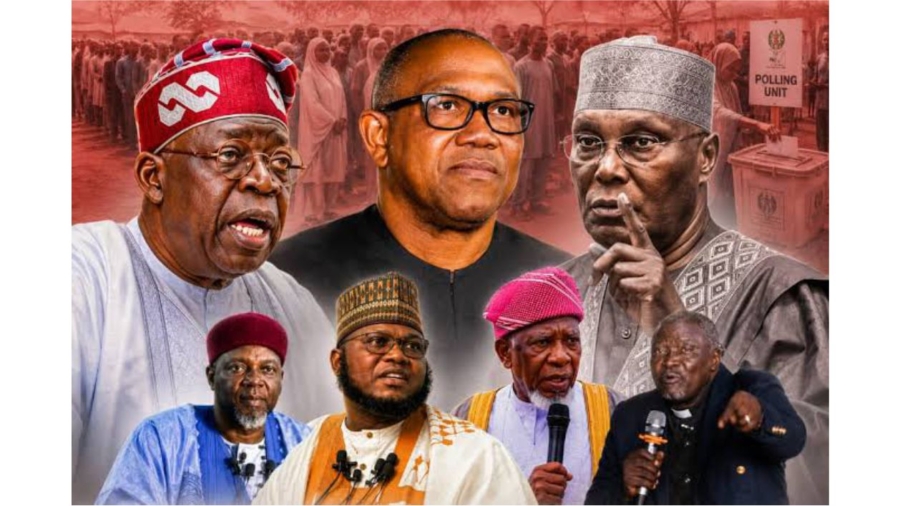
2027 Elections in Nigeria: The Candidates, the Parties and the Battle for Aso Rock
As Nigeria moves towards the 2027 presidential election, the contest is taking shape around five major tickets Tinubu, Atiku, Obi, Onor and Okereke each representing a different political calculation, coalition and vision for the country.
By Ekocity Politics Desk
Nigeria’s 2027 presidential election has entered a decisive phase. What was once dominated by speculation, defections and competing ambitions has become a clearer contest: the Independent National Electoral Commission (INEC) has published the final list of presidential and vice-presidential candidates, with 18 presidential candidates on the ballot.
The presidential election is scheduled for January 16, 2027, while the governorship and State House of Assembly elections follow on February 6.
While 18 candidates will contest the presidency, the political conversation is likely to be dominated by a smaller group: Bola Ahmed Tinubu (APC), Atiku Abubakar (ADC), Peter Obi (NDC), Sandy Ojang Onor (PDP) and Sunday Chibuzo Okereke (Labour Party).
These five tickets tell a larger story about Nigerian politics: incumbency versus opposition, established networks versus coalition politics, experience versus generational change, and traditional party structures versus movements built around individual candidates. For voters, the important question is no longer simply who is contesting. It is what each candidate represents, what coalition each can build, and whether that coalition can translate into votes across Nigeria’s complex electoral map.
1. Bola Ahmed Tinubu — All Progressives Congress: The Incumbent Seeking Another Mandate
President Bola Ahmed Tinubu enters the 2027 election as the incumbent and the candidate of the ruling All Progressives Congress, with Vice President Kashim Shettima again as his running mate on a ticket confirmed by INEC’s final list.
Tinubu’s greatest advantage is obvious: incumbency. The APC controls the federal government and commands a broad political network nationwide, giving the president access to the institutional visibility, machinery and structures that come with governing at the centre.
But incumbency is also a burden. The 2027 election will effectively become a referendum on the Tinubu administration’s record. The government will be judged on economic reforms, inflation, food prices, energy costs, employment, security, infrastructure and the standard of living. The administration can point to major reforms and investments, including changes to the petroleum sector, infrastructure development and efforts to reposition the economy. The opposition, however, is likely to make the cost-of-living crisis the centrepiece of its campaign. Tinubu is therefore not campaigning as just another candidate — he is asking Nigerians to renew the mandate of an administration whose policies have already changed the country’s economic direction.
2. Atiku Abubakar — African Democratic Congress: The Veteran Opposition Candidate Returns
Former Vice President Atiku Abubakar is contesting on the platform of the African Democratic Congress, with former Transportation Minister Rotimi Amaechi as his running mate on a ticket confirmed by INEC.
Atiku brings something few opposition candidates can match: decades of national political experience, several presidential contests and extensive relationships across the political establishment. His move to the ADC is significant — rather than contesting again under the PDP, he is attempting to assemble a broader opposition platform around a different party structure, with Amaechi adding another experienced operator to the ticket.
The strategic challenge, however, is enormous. Atiku must convince Nigerians that the opposition can unite behind his candidacy while overcoming the fatigue that often accompanies repeated presidential contests. His strongest arguments are likely to centre on economic management, democratic institutions, private-sector growth, restructuring and the need for an effective alternative to the APC. The central question remains: can Atiku convert political experience into a sufficiently broad national coalition?
3. Peter Obi — Nigeria Democratic Congress: Turning Momentum Into Structure
Peter Obi remains one of the most closely watched figures in Nigerian politics. In 2023, the former Anambra State governor transformed the Labour Party’s campaign into a powerful national movement, particularly among younger voters. For 2027, however, Obi is contesting under a different platform: the Nigeria Democratic Congress, with former Kano State governor Rabiu Musa Kwankwaso as his running mate on the INEC-confirmed ticket.
This may be the most consequential development of the race. Obi brings substantial support from the South-East and strong recognition among young and urban voters; Kwankwaso brings an established political network in northern Nigeria, particularly Kano. The ticket therefore attempts to combine Obi’s southern, youth-oriented support with Kwankwaso’s northern structure.
Whether that combination becomes an electoral breakthrough will depend on organisation. The lesson of 2023 was clear: social-media enthusiasm and passionate supporters can generate extraordinary momentum, but presidential elections are won through votes, structures, agents, logistics, turnout and geographic spread. The NDC’s biggest challenge will be converting the Obi phenomenon into a nationwide electoral machine. If it succeeds, the 2027 election could become significantly more competitive.
4. Sandy Ojang Onor — Peoples Democratic Party: A Fight for Relevance
The Peoples Democratic Party has selected Senator Sandy Ojang Onor, a former Cross River State governorship candidate, as its presidential nominee following internal consultations. His running mate is Umaru Babangida, according to INEC’s final list.
The PDP’s challenge in 2027 is bigger than the identity of its candidate — it is the condition of the party itself. For much of the Fourth Republic, the PDP was either the dominant governing party or the principal national opposition. Years of internal disputes, defections and competing factions have since weakened its cohesion, while the emergence of the ADC coalition has further transformed the opposition landscape.
For the PDP, 2027 is partly a battle for political survival. Can the party rebuild its structures, reconcile its factions, retain its traditional strongholds and persuade voters that it remains a credible vehicle for national change? Onor’s candidacy will inevitably be judged against these broader questions.
5. Sunday Chibuzo Okereke — Labour Party: A New Face on a Familiar Platform
The Labour Party presents one of the more intriguing stories of the election. Its presidential candidate, Dr Sunday Chibuzo Okereke, emerged through a consensus process and has been described by the party as a governance expert, policy strategist and reform advocate. His running mate, Hajja Bintu Konto, holds a master’s degree in public health with a background in health education and nursing.
The biggest question facing Labour is whether it can retain the political identity it built in 2023 after Peter Obi’s departure. The party’s brand became strongly associated with Obi and the “Obidient” movement — an advantage in national recognition, but a problem in that the personality who generated much of that momentum now contests under the NDC.
Okereke must therefore build his own political identity. His emphasis on governance, policy and institutional reform could appeal to voters seeking a technocratic alternative, but elections are not won on credentials alone. Labour must demonstrate the organisation and national reach necessary to compete beyond its traditional pockets of support.
The Other Candidates
The presidential field extends beyond these five stories. INEC’s final list also includes Adewole Adebayo of the Social Democratic Party, Donald Duke of the People’s Redemption Party, Omoyele Sowore of the African Action Congress, Oluseyi Makinde of the Allied Peoples Movement and Peter Agada of the Young Progressive Party, among others.
These candidates may not command the same national machinery as the leading tickets, but they can still shape the debate — attracting protest votes, influencing policy discussions or emerging as important players in particular states and demographic groups. Nigeria’s presidential election is therefore not simply a two-horse race; it is a crowded field in which further strategic alliances and realignments remain possible.
The Real Battle: Geography
Nigeria’s presidential elections are never decided by popularity alone. With six geopolitical zones, 36 states and the Federal Capital Territory, a successful candidate must build a sufficiently broad national coalition — and the 2027 contest will be fought across several theatres.
The North will remain central because of its large voting population and extensive political structures; the Atiku-Amaechi and Obi-Kwankwaso tickets will be particularly watched here, while the APC defends the federal ruling coalition. The South-West remains one of the APC’s critical strongholds and Tinubu’s political home base, though opposition parties will seek urban gains. Peter Obi’s strength makes the South-East one of the most closely watched regions, where the question is whether the NDC can maximise turnout and convert regional support into a national coalition. The South-South will be another battleground, with Onor giving the PDP a candidate of regional roots while other parties compete across the oil-producing states. And the North-Central could prove decisive: its voters have historically responded to a mixture of national, regional and local considerations, and no candidate can secure a national majority without substantial support there.
2027 Will Be About More Than Personalities
The personalities will dominate television, newspapers and social media, but voters are likely to focus on practical questions. How much does food cost? Can young Nigerians find decent employment? Can businesses survive? Can electricity become more reliable? Can insecurity be reduced? Can the naira stabilise? Can Nigeria attract investment, produce more locally and hold government to account? These questions will determine whether campaign slogans translate into votes.
The Youth Question
Nigeria’s young population will again be central to the election. The 2023 contest demonstrated the political power of younger Nigerians, particularly through digital mobilisation; 2027 may reveal whether that energy has matured into sustained participation. Young Nigerians are increasingly focused on jobs, entrepreneurship, technology, affordable housing, education, security and economic opportunity. Any candidate who treats young people merely as social-media supporters may misread the electorate — the 2027 voter is likely to demand more than hashtags. The voter wants results.
The Economy Will Be the Biggest Issue
Whatever strategies the candidates adopt, the economy will remain unavoidable. The next president will inherit a country where major structural reforms have already taken place but where millions of citizens still feel the pressure of high living costs. This creates a complicated political environment. The APC will argue that difficult reforms require time to deliver sustainable results; opposition candidates will argue that Nigerians should not endure prolonged hardship before seeing meaningful improvements. The election may therefore become a referendum on a single fundamental question: is Nigeria better positioned for the future because of the reforms being implemented today, or has their cost become too high for ordinary citizens?
The Ekocity Political Test
At Ekocity, we believe the 2027 election should not be reduced to personalities, ethnicity, religion or party colours. Nigerians deserve to interrogate the candidates directly: What is your economic plan? Your security strategy? How will you create jobs, reform education and strengthen healthcare? How will you support Nigerian businesses, deliver reliable energy, and approach devolution and restructuring? How will you fight corruption and strengthen institutions?
And perhaps most importantly: who among them has the character, competence and capacity to govern a country as complex as Nigeria?
The 2027 election will produce one winner, but the quality of the campaign should be measured by something bigger than who occupies Aso Rock. It should be measured by whether Nigerians are given enough information to make an informed choice.
The Road to January 2027
With the final presidential candidates now published, Nigeria’s political contest has entered a new phase. President Tinubu will defend his record. Atiku will attempt another national comeback. Peter Obi will try to transform the energy of 2023 into a broader coalition with Kwankwaso. Sandy Onor will carry the PDP banner in a difficult environment, and Sunday Chibuzo Okereke will attempt to build a new Labour identity after Obi’s departure.
Around them, other candidates will seek to influence the national conversation and capture a share of the electorate. The campaign will undoubtedly produce dramatic moments — defections, alliances, accusations, promises and counter-promises. But beyond the political theatre lies the real Nigeria: a country of more than 200 million people, with enormous natural resources and human talent, facing serious economic, security and institutional challenges — and whose citizens will ultimately decide who receives the mandate to lead it.
2027 is no longer a distant political conversation. The candidates are on the field. The parties have their tickets. Now the real contest begins.
EKOCITY POLITICS DESK — September 2026

Fawumi Kayode Abiodun
Political Analyst | CEO, Ekocity Media | Publisher, Ekocity Magazine and The Capitol Post
Add a Comment