

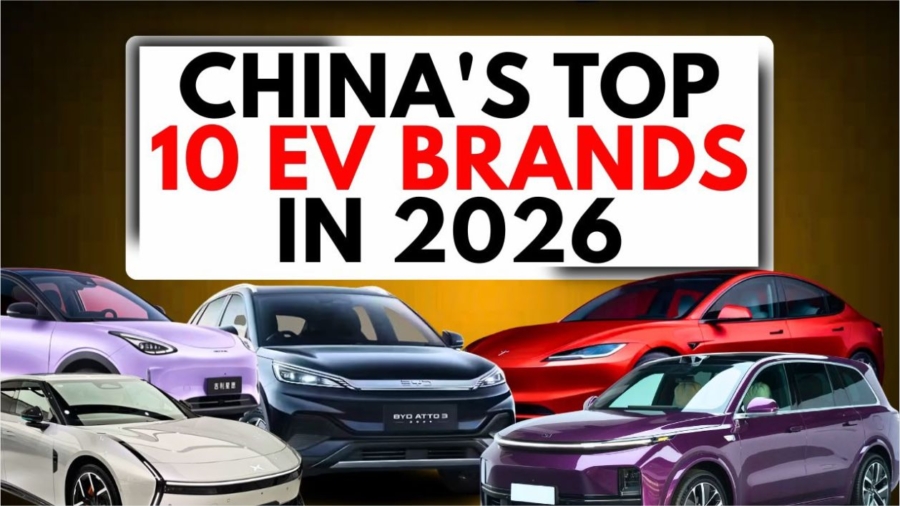
China’s Electric Car Revolution: The 10 Vehicles Redefining the Future of Mobility
By Ekocity Magazine — Business & Technology Desk
There was a time when the global automobile industry was largely a contest between Detroit, Stuttgart, Tokyo and a handful of European and Japanese manufacturers. That era is changing.
Today, some of the world’s most consequential automotive innovation is coming from China and the transformation is happening at extraordinary speed. China is not simply producing more electric vehicles. It is experimenting with a different idea of what a car should be: part automobile, part computer, part energy-storage system and, increasingly, part digital lifestyle platform.
The scale is difficult to ignore. In 2025, Chinese brands occupied 18 of the 20 top-selling new-energy vehicle models in China’s passenger-car market. The Geely Galaxy Xingyuan led the market with 465,775 retail sales, followed by the Wuling Hongguang Mini EV and Tesla Model Y. And the competition has intensified in 2026.
1. Geely Galaxy Xingyuan — The People’s Electric Car
The Xingyuan represents perhaps the most important part of China’s EV revolution: affordability.
With 465,775 units sold in China in 2025, it became the country’s best-selling new-energy passenger vehicle. Its success suggests that the electric-car revolution is no longer confined to wealthy consumers.
China’s manufacturers are demonstrating that an EV can be designed as a mass-market product rather than a luxury statement.
2. Wuling Hongguang Mini EV — Small Car, Massive Revolution
Few cars have demonstrated the democratic potential of electric mobility better than the tiny Wuling Hongguang Mini EV.
It sold 435,599 units in China in 2025, making it the country’s second-best-selling NEV.
Its appeal is simple: compact dimensions, practical urban mobility and affordability.
In crowded Chinese cities, the Mini EV turned the question from “Can I afford an electric car?” into “Why do I need a large car at all?”
3. Tesla Model Y — The Foreign Survivor
The Tesla Model Y is the outsider that continues to matter. With 425,337 Chinese retail sales in 2025, it ranked third among the country’s NEVs and was the only non-Chinese model in the top three.
Its position also reveals the intensity of China’s competition. Tesla entered China as a technological disruptor. It now finds itself competing inside the ecosystem it helped accelerate.
4. BYD Seagull — The Global Threat From Shenzhen
The BYD Seagull is one of the clearest examples of China’s ambition to make EVs accessible beyond its borders.
It sold 310,956 units in China in 2025, ranking fifth among passenger NEVs.
Its combination of compact design, battery technology and competitive pricing makes it particularly interesting for emerging markets.
For countries such as Nigeria, where affordability is likely to determine the pace of EV adoption, cars in this category may ultimately matter more than six-figure luxury electric SUVs.
5. BYD Qin Plus — The Bridge Between Old and New
The Qin Plus demonstrates another feature of China’s transition: consumers do not necessarily have to choose between conventional engines and full electrification.
BYD’s Qin family has been offered in both plug-in-hybrid and battery-electric configurations, helping consumers move gradually toward electrification.
The model recorded 387,315 NEV retail sales in China in 2025, placing it fourth overall.
6. Xiaomi SU7 — When the Smartphone Company Builds the Car
Perhaps no Chinese EV better captures the convergence of technology and transportation than the Xiaomi SU7.
Xiaomi was already known globally for smartphones and consumer electronics. Its decision to enter automobiles demonstrated how China’s technology companies increasingly see the car as another connected device.
The SU7 sold 258,164 units in China in 2025, placing it seventh among NEVs.
Its significance goes beyond sales.
It represents a new philosophy: the modern automobile is becoming a software platform with wheels.
7. BYD Seal 06 — The New Mainstream
The BYD Seal 06 was another major performer, recording 220,317 retail sales in 2025.
Its importance lies in the breadth of BYD’s strategy. The company is not relying on one breakthrough model. It is building an entire portfolio covering compact cars, sedans, SUVs, premium vehicles and commercial transport.
That scale gives BYD something many competitors lack: the ability to compete across almost every price category.
8. BYD Yuan UP — China’s Compact SUV Formula
The Yuan UP, known in some overseas markets as the BYD Atto 2, represents China’s push into the compact SUV market.
It sold 189,277 units in China in 2025.
Its appeal reflects a broader global trend: consumers increasingly want the elevated driving position and practicality of SUVs without necessarily accepting the fuel consumption associated with conventional petrol-powered vehicles.
9. XPeng Mona M03 — The Software-First Challenger
XPeng’s Mona M03 sold 175,345 units in 2025, placing it among China’s top-selling NEVs.
XPeng has positioned itself around intelligent vehicles, software and advanced driver-assistance technology.
That competition is becoming increasingly important because China’s EV battle is no longer simply about battery range.
It is about computing power, connectivity, driver assistance, charging and the ability to update a vehicle after it has left the factory.
10. Li Auto L6 — The Family SUV
Li Auto’s L6 sold 166,516 units in China in 2025.
The model illustrates another side of the Chinese market: consumers are willing to pay more for technology-rich family vehicles when the product combines practicality with sophisticated electrified powertrains.
The Real Revolution Is Bigger Than the Cars. The extraordinary part of China’s EV story is not that it has produced ten impressive vehicles. It is the industrial ecosystem behind them.
Battery manufacturers, semiconductor suppliers, charging companies, software developers, vehicle manufacturers and component producers are increasingly connected within one enormous manufacturing ecosystem.
BYD’s September 2026 figures offer a glimpse of the scale. The company reported 463,561 global vehicle sales for the month, including 273,143 battery-electric vehicles, while exports reached about 180,700 vehicles. Reuters reported that overseas passenger-vehicle and pickup shipments rose 153.9% year-on-year.
Meanwhile, Chinese competitors are expanding rapidly. Leapmotor delivered 105,656 vehicles in September, while XPeng delivered 41,256, Xiaomi more than 40,000, NIO 37,408 and Zeekr 37,216. The result is a new kind of automotive competition.
Western manufacturers spent decades building brands around engineering, reliability and prestige. Chinese manufacturers are increasingly competing around speed, affordability, batteries, software and features.
Reuters recently noted that Chinese automakers can develop new models in roughly 18 months, putting additional pressure on established global manufacturers. And Then There Is Africa.
For Africa, China’s electric-car revolution may eventually prove more consequential than it appears today.
The continent has enormous urban populations, rising transportation costs and rapidly expanding demand for mobility. But it also faces a fundamental infrastructure problem: charging networks remain limited in many markets. Nigeria illustrates the challenge.
Electric vehicles will not become mainstream simply because affordable Chinese models arrive at Nigerian ports. The country will need reliable electricity, charging infrastructure, financing, maintenance networks, battery expertise and clear government policy. Yet the opportunity is enormous.
A country that currently spends billions importing petroleum products could eventually begin shifting part of its transportation economy toward electricity particularly if EVs become affordable enough for mass-market consumers and commercial operators.
For Nigerian businesses, this could create opportunities far beyond car sales: charging stations, battery services, fleet management, vehicle conversion, renewable-energy integration, spare parts, software and electric public transportation.
That is why China’s electric-vehicle revolution deserves attention in Nigeria. It is not simply a story about cars. It is a story about energy, technology, manufacturing, trade and the future of African transportation. China has already demonstrated that electric vehicles can be produced at extraordinary scale.
The next question is whether Africa will merely become a destination market for those vehicles or whether it will build the infrastructure and industrial capacity to participate in the revolution itself. The electric car may be China’s product today. But the future of mobility is becoming everyone’s business.

Fawumi Kayode Abiodun
Political Analyst | CEO, Ekocity Media | Publisher, Ekocity Magazine and The Capitol Post
Add a Comment